

7.62×39

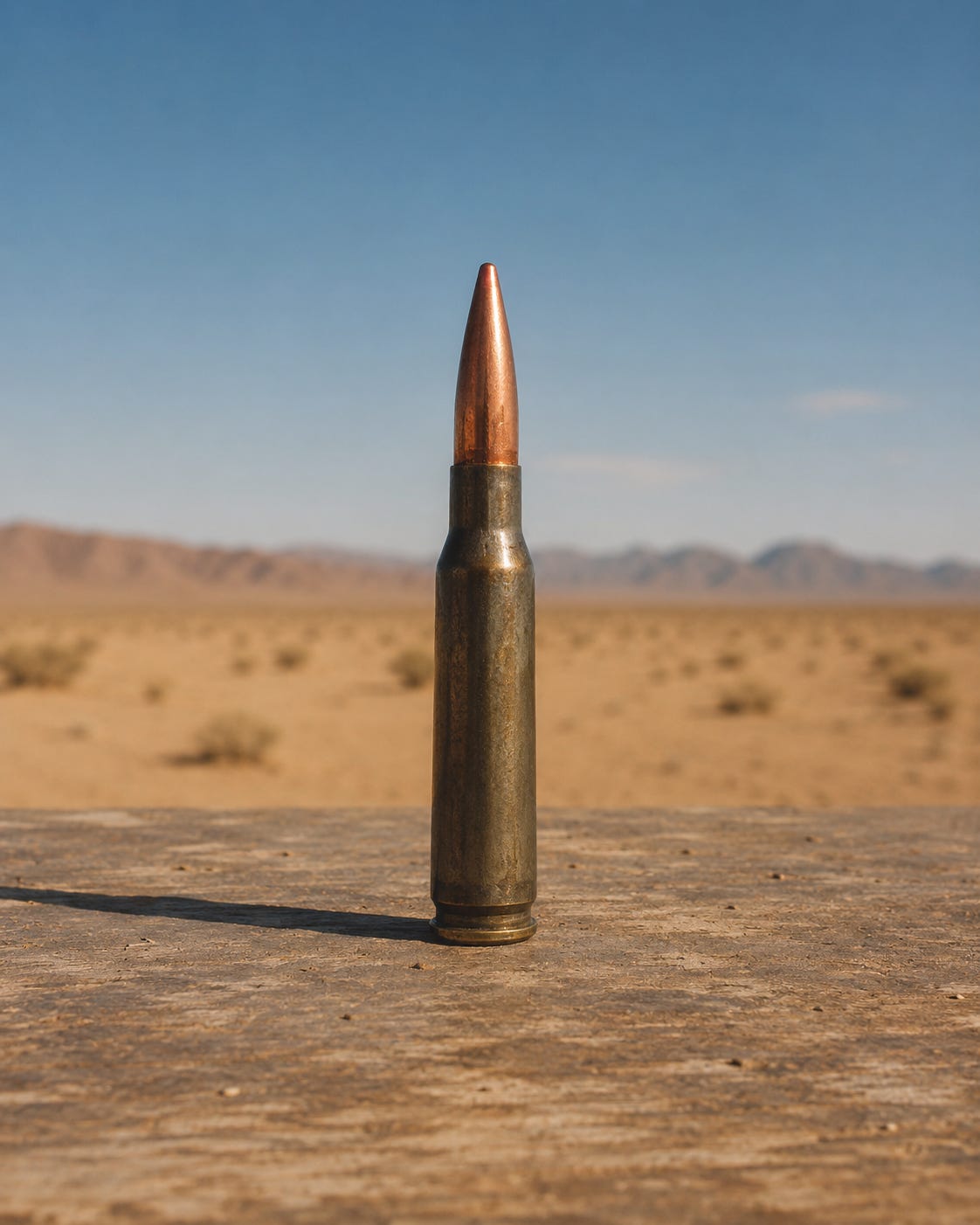
A 7.62×39mm round leaves the barrel already dying. Born in fire and dreaming to take something with it.
The powder ignites and the expanding gas hurls the bullet down the rifled barrel hard enough to engrave spiraling grooves into copper and lead, spinning it at something close to two hundred thousand revolutions per minute, a tiny mechanical planet screaming through the air at roughly twenty-three hundred feet per second. Supersonic. Faster than the sound trying to catch it. The round carries its own crack with it, a violent tearing of atmosphere following behind like a whip. But inside a helicopter the turbines are already shrieking so loudly that the sound disappears into the machinery. The engines drown God himself, if he were to care for such places. You never hear the shot that kills you. You hear only turbines and rotor slap and hydraulic whine and the screaming metallic labor of the aircraft trying to remain in the sky.
Then the round.
Aircraft aluminum is thin because that keeps helicopters flying. A 7.62×39mm round enters that aluminum and leaves a hole almost exactly its own diameter. Seven point six two millimeters. You could fit your little finger in it. The metal dimples inward for a fraction of an instant before failing, and the aluminum peels back at the point of entry so slightly you might miss it unless you’re looking right at it. If you saw only the entrance hole you might think it was harmless. Clean. Precise. A drill bit could do this. A nail gun could do this.
But the round is not done when it enters.
Inside the aircraft the bullet begins to yaw. A rifle round is stable in open air because spin and velocity hold it nose-forward, but when it strikes resistance the balance destabilizes and the bullet starts trying to turn sideways. Sideways, a bullet stops behaving like a needle and starts behaving like an axe head. It does not pass through things then. It tears them open. The copper jacket deforms. The lead core carries forward under impossible force. Metal parts around it. Anything wet bursts. Anything brittle shatters. Anything soft becomes temporary.
And because the round is still moving faster than sound inside the cabin, the pressure wave arrives before understanding does. Before fear. Before thought itself has fully formed. One moment there is solid aircraft skin six inches above your head. The next there is daylight. Thin white lines of desert sunlight punching through the cabin where metal used to be. Matter removed so violently and so instantly that your brain cannot process the transition quickly enough to call it danger.
The entrance, though, is seven point six two millimeters.
One round is seldom enough to bring down a helicopter. Many are rarely catastrophic. The aircraft is designed to absorb this. The hydraulic lines are redundant. The composite rotors can absorb them. Unless, of course, we were in the way. Unless the line those rounds were on, fired from a gun half a mile below by a man who would never see our faces, happened to pass through the space where we sat. Mortal bags of blood and bone and fluid, sealed in skin, waiting in the most literal sense to be spilled upon this thirsty earth.
The heat was off the turbines. Three of them. The exhaust pouring over the fuselage and baking everything it touched until the sweat ran and your flight suit stuck to you and the metal burned your hands through the gloves.
I was looking down. Out the crew door, the way I was always out the crew door, surveying the soldier below as he hooked another piece of equipment to the cable. Routine. A kind of routine that makes you believe the world has an order to it and that you are inside the order.
Then the holes.
I did not hear them. I did not feel them. They did not touch me. They carved an arc six inches above my head, a line of seven-point-six-two daylight opening up in the skin of the aircraft where there had been solid metal a fraction of a second before, and I was already in motion and across the bird the other crew chief punched the button that set off a squib, severing the cable instantly, and the load fell away and I was already lowering the barrel of my gun toward whatever was below us trying to kill us.
Time crawled. A second, an hour, same thing. I listened. For changes in pitch. For rattle. For echo. For some sign that the machine was distressed in a way that foretold a fiery and bloody death and nothing left but maybe dog tags. But the machine kept turning. The machine kept turning and we were still in the air and I was still alive and the holes were six inches above where my head had been and I have no idea what was said. Someone said something. Someone always has to say something to spur action. I did not hear it. Or perhaps I did, and I don’t remember. I might’ve been the one that said it.
The machine banked hard. Away from the bullets. Away from whatever below us desired us dead.
Then I looked at him.
The other crew chief. Across the bird. And his face.
I have tried to tell people about his face. I have tried for years. Civilians hear the story and they want the fear. They want the almost-died part. They want to know what it feels like when the round misses your head by six inches and I can tell you what it feels like. It feels like nothing. You don’t feel it. You feel it later, alone, when your hands won’t stop shaking and you can’t figure out why you’re crying in the shower at zero-dark-whatever. In the moment you feel nothing because your body has taken over and your body is not interested in feelings. Your body is interested in keeping you alive for the next four seconds.
But his face.
I saw fear. That’s expected. Everyone wants to hear about the fear. I saw pain, and sadness, and those are easy too because they belong there, because they make sense when the world acts as it is expected.
Then I saw joy.
I know how that sounds. I don’t care. There was joy in his face and it was the most terrifying thing I have ever seen, more terrifying than the bullets, because the bullets I understood. A man tries to kill you and you try not to die. That makes a twisted kind of sense. Joy does not. Joy has no business being on the face of a man who just watched seven-point-six-two millimeters come ripping through the skin of his aircraft six inches from his friend’s skull. But there it was.
And I don’t know if it was his or mine reflected back at me or the joy of the body discovering it is still…there. I have thought about it for decades and I do not know. That troubles me. Not the bullets. The joy. The bullets I have made my peace with.
The joy I have not.
His face was the most human thing I had ever seen. In a church. Holding my kids for the first time. Name any of the places where you expect to find the full unguarded human being. A helicopter with holes in it. That’s where I found it. A man across from me whose face had been stripped of every single thing he had ever used to keep the world from seeing him, because the bullets took it. They don’t ask. They don’t negotiate. They don’t give you a second to decide what you’re willing to show. And what was underneath was him. Just him. The actual human being that had been in there the whole time under all the shit we wear to get through the day, and he was looking at me and I was looking at him and neither of us said a goddamn thing because there was nothing to say that was bigger than what was already happening between us.
I did not know what I was seeing. I knew it was important. Some feral knowledge that resides in the lizard brain and the manual was lost eons ago.
I was looking at a human being who had been stripped all the way down by seven-point-six-two millimeters of copper and lead, and what was at the bottom was not what we are taught to expect. We are taught that the thing underneath the performance is fragile. That it needs the protection. That without all the shit we pile on top of it the actual self will be exposed and the exposure will destroy it. That is a lie. The actual self is the strongest thing in there. The actual self is what was waiting to be used.
The self is not the thing being protected. The self is the thing being offered. Everything we spend our lives building around it, the toughness, the composure, the carefully curated vision of ourselves we show to the world, all of that is the protection. And the protection is not protecting us. It is preventing us from being used the way we were built to be used. Completely, without reservation, with nothing kept back, the way the two of us were used in that helicopter when the bullets took the choice away and we were, for maybe the first and maybe the last time in our lives, fully here.
That is the closest I have ever been to another person. Not even my kids, whom I love more than I have the ability to say. A helicopter with holes in it. That is where I learned what the human looks like when the performance has been ripped off of it and the person underneath is standing there with nothing between them and the world.
People who give themselves over to something and people who do not are quite different. The ones who gave themselves over, every one I have ever met, have something in their faces. Quieter than what I saw in the helicopter. More weathered. Reached by a longer road. But the same thing at the center of it. The paint is off. The performance is done. They went into something and it changed them at the level where change counts and they came out different and the difference is visible if you know what to look for.
The ones who do not give themselves over are safer. Most assuredly safer. I do not say this ironically. The safety is real. The life behind the performance is a real life with real love in it and real value, and I will not stand here and tell you it is nothing. But there is a something missing. There is a dimension of presence that only comes from having been burned down to the actual self, and without that dimension a person lives their whole life at a safe and reasonable distance from themselves, and they are most assuredly safer for it, and they are, in some final sense, absent. Not from life. From the part of life that makes the rest of it make sense.
People see someone who has given everything to a thing and they see sacrifice. They tally what was lost. The careful life. The safe road. The protected self. And they are right that those things were given up, and some of the losses were real, and I will not pretend otherwise. I have the scars from the cost and so does everyone I know who has been through it.
But the cost is the entrance fee. The price, though, is never the story. What they do not see, because they have never been inside, is that the thing being sacrificed was the thing that needed to go. That the self being offered up was never the real self. It was the shell over the real self. And the armor was keeping the self from being used, and a self that is never used is a self that was wasted, and there is no sadder waste I can think of than a human being who goes their whole life with the real version of themselves sealed inside a performance that nobody, including them, ever looked behind.
That’s all I think I’ll ever know about giving yourself over to something. I learned it in a helicopter with holes in it. The bullets did the teaching. His face was what I learned. And what I learned was that everything I had been building to protect myself from the world was the thing standing between me and the world, and the world was what I was here for, and the only way to get to it was to let the protection go, either because the bullets took it or because I took it off myself, one piece at a time, for the rest of my life, which is what I have been doing since, and which is the only thing I have ever given a damn about.
How you get there does not matter. Bullets. A guitar. A woman who will not let you hide. A cause that will not let you rest. A truth that burned its way in and will not let you go back to sleep. The method is just the version of fire that found you. What matters is whether you went in. Whether the false part burned off. Whether you stood there with the actual self showing and did not flinch.
The question is not whether the fire has hurt you.
The question is, have you finally discovered what it is to be warm?
Wow, Joe. This is possibly the most beautifully terrifying thing I've ever read.
Not quite sure how to process it yet. But thank you.
Nothing, absolutely nothing, has the power to move the heart and mind like the written word in the hands of someone who knows and has experienced Something. The feeling I had from getting letters from a neighborhood boy stationed in Cam Ranh Bay surfaced for me today. Exquisite writing, Joe. Thank you.