

A Nod to Abdication

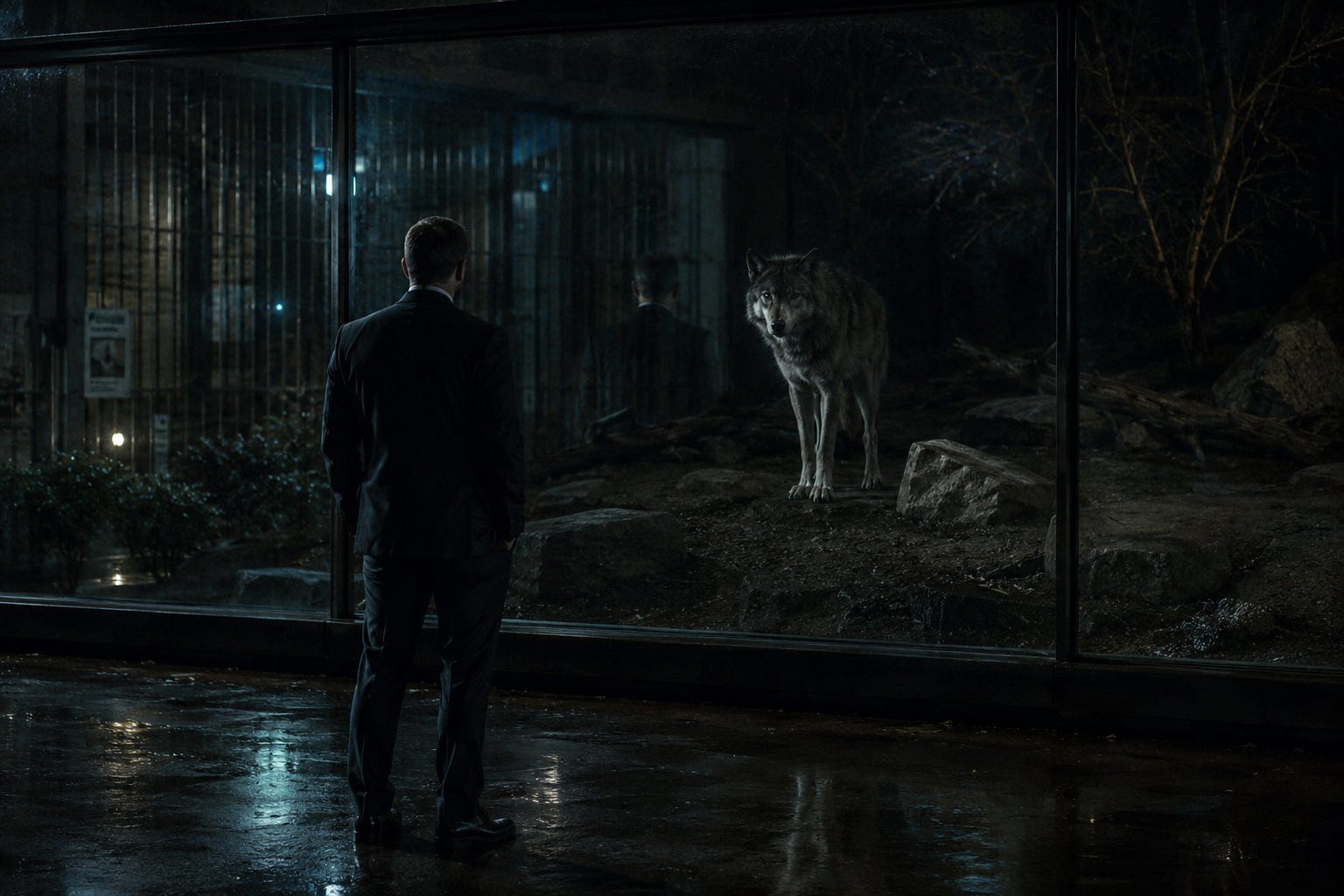
We speak of the animal in others with a trembling reverence we reserve for nothing else.
Not for God, not for beauty, not for death, though death at least has the decency to be honest. We face it across dinner tables, across darkened rooms, across the catastrophe of human contact. We are magnetized by it. The unfettered laugh. The unguarded hunger. The person who takes what they want without first summoning a committee to debate whether they deserve it.
We label this silliness attraction. Or worse, chemistry. Or, if you choose, desire because desire, at least, sounds like something we have chosen.
It is, however, confession.
What we are confessing, in our helpless orbit around those who seem to live without the trembling self-awareness that governs our every breath, is that we are imprisoned. Not by circumstance or by society, though society is a most willing accomplice. We are imprisoned by our own trembling, meticulous, endlessly industrious hands. We built this prison. We commissioned it. We spent the better years of our lives perfecting its locks, gilding its bars, and hanging small tasteful paintings on its walls so that it might feel, on the better days, less like an enclosure and more like a personality.
The fable of the civilized animal. The belief in the restraint as self.
That the act of composure is identical to possessing it. That the wolf who has learned to dine at a table and use cutlery is no longer a wolf but something higher, dare I say, refined. We have confused the suppression of our nature with rising above it, and we have made this so thoroughly confusing, and with such devotion, and with such collective agreement, that to point it out now feels hideous.
Rude.
Which is, of course, precisely the point.
The animal in us did not die. It does not die. It cannot be educated out of existence, it will not be shamed into darkness, and it will never drown in the baptismal font of self-improvement. It watches. From whatever place we have assigned it, it watches us go about our days, our careful apologies, our managed tones, our exquisitely faked expressions of the acceptable emotions, and it does not rage, which would be almost bearable. It simply watches. Patient. Waiting. With the devastating patience of something that knows it is not going anywhere.
We feel this. We feel it and we cannot say it without exposing ourselves. So instead we admire it in others.
We find someone who behaves differently. Who speaks without the habitual half-second delay we have trained ourselves to insert between thought and word, that small, civilized pause in which we kill approximately half of everything true we might otherwise say. Someone who seems to inhabit themselves with ease. Someone who gets angry, without the agonizing weight of cost/benefit. A person who wants things openly, which in our world is an act so radical it reads as charisma, dangerous, sexy.
And we are helpless. We hate them a little for it, which is the surest sign that we love what they represent. We circle them. We make up reasons to be near them. We study them the way the devout study scripture, hunting for the secret, the technique, the ‘how’ that explains the escape. How they fled the thing we cannot even fully see that we are trapped inside.
We will not ask them directly. That would require acknowledging our own prison. Instead we pretend it fascination. We are drawn to their energy. And, yet again, we dress it in aesthetics and attraction so that what is actually happening, a caged thing pressing its face against the bars to watch a free thing run, can remain, for the sake of our dignity, partially obscured.
Our dignity. Which is itself, of course, a bar on the cage.
The restraint is not the self. This truth is so simple and so annihilating that civilization has spent several thousand years building elaborate stories to prevent anyone from sitting quietly with it.
Philosophy.
Theology.
The novel.
The self-help industry and its relentless assembly of new languages for the same capitulation. What we state is character is mostly armor. What we claim is virtue is frequently just being exhaustion by desire, not its mastery. The man who announces he is not tempted has usually built his life so carefully around the avoidance of temptation that the avoidance has become his life.
Honesty would entail admitting it is not that we rose above our nature. Honesty is that we are savage creatures who occasionally, briefly, manage not to act like it. And who have constructed entire civilizations, philosophical traditions, and religions, not to elevate us above this fact but to distract us from it. To give us something elaborate enough to look at that we do not have to look at ourselves. And when the distraction fails, and it always does, when we find ourselves with our composure shattered and the horror of our own visage staring back at us from whatever dark surface we have stumbled toward. And yet, we do not feel fallen. We feel, for the first time in ages, real.
That animal moment, the moment of pure unadulterated want or rage or grief or joy, does not feel like a failure of the self but finally coming into it. That the cage, which we have spent our lives defending as the construct of personhood, reveals itself in those moments to have been all along a substitute for it.
So we project. It is the oldest and most elegant of the psyche’s maneuvers, and we should give it its due, it is genuinely impressive as a piece of engineering. We take what we cannot bear to acknowledge in ourselves and we install it, carefully, in the person across the room. We let them be the animal. We let them carry the heat and the darkness and the gorgeous dangerousness of the unlicensed life. And then we tell ourselves we are attracted to them, as though we are appreciating something foreign, something other, something excitingly outside our own quiet nature, when in fact we are voyeurs at the window of our own locked house, watching ourselves walk free in the street below.
The longing we feel for the unrestrained other is not the longing of one creature for another. It is the longing of the prisoner for the wild. It is the amputee’s phantom ache. It is the irremediable grief of having lost something that was not taken from you but surrendered, and surrendered so long ago, so incrementally, that you cannot locate the moment of loss.
The cruelty, and there is a cruelty at the heart of this that we should refuse to soften, is that we will not, in most cases, unlock the door. I am not advocating in favor of unlocking the door. Life is not served by bright little injunctions to live your truth and set yourself free, those incantations which have all the depth of a spa menu and roughly the same consequences. The captivity is real. The bars are real. What we have built our lives upon, our relationships, our work, our entire apparatus of being considered good and safe and reliable, is often built, brick by careful brick, on the foundation of the animal’s captivity. To release it now would not be liberation.
It would be in any sense, destruction.
What is being asked, what this costs, is not action. It is honesty. The honesty of admitting that the life you are living is, in some places, not yours. That the person you turn toward the world has been, for a long time, assembled rather than inhabited. That when you are undone by the wildness of another person, you are not encountering the foreign. You are grieving the familiar.
The animal is not something you lost. It is something you are still in the process of losing, daily, through every capitulation to the more convenient self. And you know this. You have always known this.
The attraction betrays you.
What beauty there is in the beast you will not become. What a monument we make of our own abdication. We have learned to call the cage by so many lovely names, restraint, maturity, grace, wisdom, the hard-won peace of a life well-managed, that we have made a genuine art of our imprisonment. We create literature to it. We build philosophy around it. We are, it must be admitted, magnificent captives.
Eloquent in our chains. Elegant in our losses.
But the animal knows. And in the presence of its own wild kin, it presses forward. And the bars hold.
And we call what we feel in that moment desire, because to call it what it is, recognition, would be the end of everything we pretend to be.
And so the sentence endures. And so does the longing. And so do we, a part of us, anyway.
The other half stopped being us a long time ago, and learned, with remarkable grace, to answer to our name.