

One More Beautiful Thing

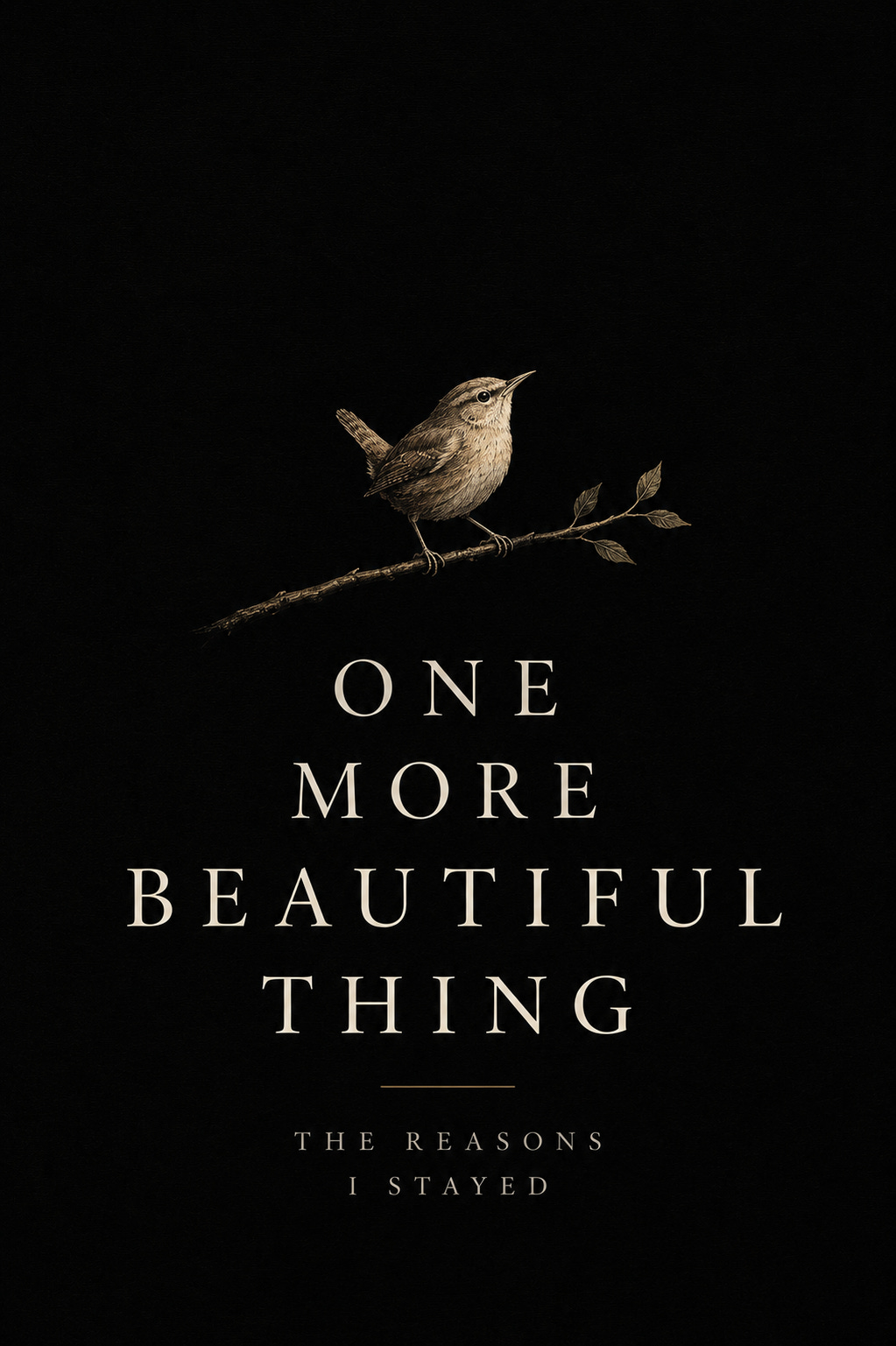
People want the story of aborted suicide to turn on something monumental. When they learn how close it came, and they ask, because they always ask, they are waiting to hear about the children, or love, or God, or some voice that spoke in the dark and sent me back. A reason the size of the decision. I understand that desire. A thing that enormous should be answered by something equally enormous, or it feels a bit obscene.
It was none of that. It was a wren. It was a badge. It was the idiotic persistence of a world that would not stop being beautiful long enough for me to leave it, that kept feeding its young and turning strangers’ heads and producing, against all sense, one more sentence worth reading back. The reasons people offer are too grand. What actually got me was small, and overlooked. These are the things that were here the whole time. These are the things I almost did not stay to see.
The world decided not to participate in my tragedy
On the day of my greatest sorrow the dog still needed to be walked. It came to the door and laid it down, tail going, knowing nothing of my sadness,. And while I stood there with it, the most foolish small things kept happening, none of them aware of me. A wren went in and out of the trees, feeding something hidden, frantic, tireless. A neighbor two gardens down called a dog that would not come, called again, half laughing. The clasp of a flag line snapping against the pole. Somewhere a radio played a song too cheerful for this day.
We expect grief to be met. We expect the sky to grey, the clocks to falter, some great hand to still the traffic in deference to what we have lost. It does not happen. The dead leave and the bees go on pollinating the flowers. There is a loneliness in this, and also, if you can bear to look, a kind of tenderness: the morning does not stop because you cannot possibly stop it from being beautiful. The same grey that passed over your sorrow will, in its season, be the thing that allows you stand. It asks nothing. It only continues, the door left open for whoever can still walk through it.
Beauty survives contact with horror.
In the photographs of ruined cities there is nearly always a incongruous detail. A geranium on a windowsill above the rubble, still red. A line of washing strung between two gutted walls, the shirts lifting in a breeze that cares not what has transpired. A dog asleep in a patch of sun. The eye goes to the destruction and then, helplessly, to the small living thing that refused it.
Beauty has no decency. It does not wait until the suffering is over. It blooms in the cells of the condemned and the wards of the dying, it frosts the windows of the worst nights, it puts a blackbird singing over the funeral procession. We would prefer it to be loyal, to withdraw in protest, to refuse to shine on what should not be. It will not. And so it becomes, against everything, a strange argument. The world was never built only for our pain, that something more stubborn than destruction and pain keeps laying its small gold leaf over the carnage, indifferent and merciful at the same time.
You have never seen the final…anything.
The river behind my old house is never the same river. The children who once swam in it, me included, are grown and scattered to the wind. The willow that hung over the water fell in some storm no one remembers, and another has taken its place unbidden. Even the sun dancing on the surface is leaving, gone by the moment you have seen it. You return to the same bend you swam the day before and find a stranger.
Nothing you love is finished. The face across the table is still being made, sorrow by joy, into a face you have not yet met. The place you live is a draft. Your own hands are a draft. We move through a world that is forever wet paint, and our great error is to believe we have ever seen the completed thing, to mourn it as though it were settled, to praise it as though it would keep. There is no final version. There is only the next one, forming while you sleep, and the absolute grace of being allowed to witness a little of the sentence before it is taken from you, unfinished.
Every person contains an undiscovered universe.
A mother sits in a chair outside surgery, a sleeping child against her shoulder, looking at nothing, swaying a little out of a habit her body has not forgotten. You take her in for a second on your way past. Tired woman, small child. Then she is behind you and gone. And in her, just then, a whole life is going on at once. Perhaps a sea she swam in as a child, a man who is not the child’s father, a diagnosis from a doctor she has told no one, a tune she cannot place that has been with her since birth.
Every person you pass is more than you will ever know of them. Behind the tired face is a universe undiscovered, lived in, destroyed and rebuilt a hundred times over, and you will never go in. The old man dozing on the bus once loved someone so much the stars seemed to move for him. The woman in the waiting room is a world entire, with her own dead in it, her own summers, her own God she argues with at night. We move among billions of these and think we are alone. Perhaps the deepest solitude is that each of us is a universe lit from inside, brimming, singular, and nearly none of us will ever be entered by another, not fully, not ever.
Existence keeps producing unnecessary wonders.
No survival depends on the green stripe of a beetle’s back, and yet there it is, lacquered, ridiculous and perfect. The inside of the shell is polished to a gleam no eye was ever meant to see. The peacock can barely fly for the splendor it drags behind it. Snow falls in patterns too intricate for any purpose, and then melts before anyone has counted them, and falls again the same way, prodigal beyond all sense.
And we cannot account for any of it. The world had no need to be beautiful in order to function. A grey would have done, and done so efficiently, perhaps even more perfectly. The atoms could have gone about their business without the sunset, without the smell the earth gives up after rain, and absent the strange color that shows in a child’s hair late upon a setting sun. And yet existence pours out these extravagances by the billion, unasked, unthanked, most of them falling in forests no one walks, on seafloors no one will ever tread. We are surrounded by a generosity so vast and so pointless that it begins to feel like a message we were never taught to read.
Most of life is hidden from history.
In the drawer there is a photograph that fell from a secondhand book I purchased and no one knows who they are. A young couple, squinting into a long-dead summer, dressed in their best. Someone loved them enough to keep this. Someone, later, did not know to ask. They had a whole life, mornings and quarrels and the smell of their house alive with baking or dinner, and all of it has gone down now into the silence, leaving this one square of paper that says only: Here, once, were we.
History keeps almost nothing. It records the kings and the battles and the dates, the loud and the cruel, and lets the rest fall through the cracks of time. But life was never lived in the headlines. It was lived in the unphotographed evening, the joke between two friends now both gone, the way a mother sang to a sick child, the ten thousand small kindnesses that left no trace. Nearly everyone who ever lived has vanished utterly, taking their laughter and their sorrows with them, and the earth does not even remember their faces. We are the brief visible foam on an ocean of the forgotten, and one day the foam that is us will go down too, into that same tender dark, unrecorded, and somehow, miraculously, not diminished by it.
Love is wildly disproportionate.
My father’s badge sits on my desk and I pick it up before I know I have done it. Years dead and the metal asks nothing of me, but my thumb finds the worn face of it the way it must have found his hand when I was small enough to be led, the only motion I own. I breathe on it. I bring back the shine when it sat upon his chest. And for as long as the polishing lasts he is not gone, he is back in our house, he has set it down and will be back for it, and I am a boy who has not yet been told the one thing that cannot be untold.
There is no economy in love. It will spend a lifetime of devotion on a single, vanished person and consider the exchange more than fair. It will grieve a small animal with a sorrow it would be ashamed to admit, will guard a child’s first shoe past all reason, and will travel across the world to sit for an hour beside a silent hospital bed holding a hand grown cold. Measured against the indifferent scale of the universe, against the cold tally of stars and extinctions, this makes no sense at all. A creature so brief, loving so hugely, with so little hope of keeping what it loves. And yet this disproportion may be the truest thing we do or are, the one place where we openly defy the size of things and insist, against all evidence, that one face mattered more than the whole spinning indifference of space.
Reality keeps refusing cynicism.
I had decided people were mostly awful and I had earned this honestly. The evidence was decades of living and all of it is true. Then a person, when I could barely answer, when I had nothing left in me for anyone, looked at me a moment too long and said take care of yourself, the way you only say it when you have seen something in a face, and meant it, to a stranger you would never see again, for nothing, expecting nothing back. I made it to the car before it reached me. A small thing. It undid none of the cruelty I had been reading all week. And still my case against the world, the one I had built so carefully and needed so badly, lost something critical I could not afford to lose.
Cynicism is the most reasonable position a man can take and the world keeps making a fool of it. Every argument for despair is sound, and then a nurse stays past her hours to sit beside someone else’s father so he will not go into the dark alone. People with every reason to be bitter keep planting trees whose shade they know they will never sit in. The cruelty is real and the despair is intelligent and neither of them gets the last word, because the last word keeps turning out to be some small undeserved tenderness no theory asked for and no theory can account for. Reality is kinder than our conclusions about it. It goes on quietly humiliating the part of us that has sworn off hoping, slipping grace in exactly where we promised ourselves none would come, until even a man who had decided is standing in a car park with his keys in his hand, undone by a stranger, ashamed of how badly he wanted to be wrong.
Consciousness exists at all.
Some things are so small I almost miss it every time. A child’s hair under my fingers, the impossible fineness of it, finer than anything else I will ever touch, warm from the head it grows out of, alive in a way that nothing made by a human is alive. And the other one, the toothless grin that opens for no reason, for the sheer animal joy of a face it has decided to love, holding back nothing, certain of a welcome the world has not yet taught it to doubt. I do not deserve either. I sit there with my hand full of that hair and that grin turned up at me, and what gets me is not only the love of it. It is that the warmth is going somewhere. That it is being received, in a small place inside me that no surgeon could find, and that the same impossible place has switched on inside those little heads too, a within that did not exist and now does, looking back out at me. I am, for this minute, being shown the everything, the entire unrepeatable miracle, and I am now ashamed that I will spend most of my life too tired or too afraid to witness it.
This is what we are most asleep to and it is the only truly strange thing there is. The same dust that lies dead in the dark between the stars is, here, in these small ones and in me, sitting up and feeling itself, laughing and reaching for a face, afraid of the dark it came from and not yet unafraid, both at once. Everything else can be accounted for. Not this. Not that the cold should wake and know that it is warm, that a few pounds of quiet matter should remember and grieve and be glad, that two of these mysterious and magical places should find each other and reach across the small distance between them that neither will ever truly cross. For a few years the universe has opened its eyes in us, astonished and tender and doomed, and the little ones do not yet know they are doomed, which is its own mercy and its own grief. I will give mine back before they give theirs. The hair will coarsen and the grin will fill with teeth and the fact of being someone will move on through them and out past me, and the dark will close over all of it as if no one had ever been home. That any of us was in here at all, that the cold thing woke and laughed and reached for another face before it slept again, is a wonder no one can explain to me. Most days I am too tired to feel it.
Then, this once, with that hair under my hand, I am not.
The fact that you can still be surprised.
After so many winters, the first snow still stops you at the window like a child. You know perfectly well what snow is. You have seen dozens of these falls, you could explain the whole science of it, and none of that helps. The flakes come down, slow and uncertain, settling on the bare branches, and something happens in you that you cannot govern, an astonishment that all your knowledge has never managed to wear away.
You would think the surprise would run out. We are repetitive creatures living repetitive days, and by now we have seen the sun rise something like twenty thousand times. By every reasonable measure we should be bored to the bone with existence. And we are not, quite. A lyric from a song undoes us. A face we have loved for forty years suddenly looks new across the table. The capacity to be amazed survives everything that should have killed it, every disappointment, every funeral, every tedious and identical morning. As long as something can still stop us without warning, some part of us has not yet agreed to die, and is still turning toward the world like a plant toward the light, expecting, against all the evidence of a lifetime, to be astonished once more.
People keep choosing each other.
Two people are in a place neither had much reason to be, on an evening either might easily have stayed home from, and some small thing turns one head toward the other instead of toward any of the dozens standing just as near. That is all it is. A turn that could have gone the other way and did not. Whole lives are decided in that half-second by something that feels at the time like nothing at all, and most spend the years afterward trying not to think too hard about how close they came to walking past the whole of it without ever knowing it was there.
Two people, out of the billions alive and the billions gone. Born into the same brief century, the same few miles. Surviving every illness and accident and wrong turn. Standing in one small place at one unrepeatable minute, both lonely enough to look, both unguarded enough to speak. The odds against any two ever finding each other are so vast they should forbid it, and still it happens, in every town, on every afternoon, strangers crossing the one gulf no one ever truly crosses and coming to rest on a single word, you, this one, out of all of them, you. We think it nothing because it is everywhere. It is the least likely thing there is. Two specks in an indifferent dark choosing each other against everything, and building from it, almost in passing, a life. Most come within a turned head of missing theirs. That anyone finds another at all is the nearest thing to grace we are given, and none of us earns it. We only turn, or fail to.
The universe contains laughter.
Two men who have just buried someone they both loved are standing apart from the others, and one of them says the thing the dead man would have said about his own funeral, the joke he would have made about the flowers or the priest or someone nobody invited, and they laugh. Helpless. Shoulders shaking, faces wet, turned away so the family will not see, and they cannot tell anymore whether they are weeping or laughing because now there is no difference. It is the body refusing to choose, grief and joy pouring out of the same loss. It is the most alive either of them has felt in a week. And it is for him. It is the last gift he gives them, that even gone he can still do this, still reach up out of the grave and knock the solemnity clean off the day.
Nothing made us this way on purpose. Fear was enough to keep the species breathing. A creature that ran from the lion and mourned its dead would have lasted just as long without ever once being seized by the wrong laugh at the wrong moment. But we are the only animals who know with certainty that we are going to die, who carry the date toward us our whole lives, and the same creature that knows this is the creature that laughs hardest exactly where it should not, in the ward, in the trench, at the graveside, in the hell a man goes when he has decided and not yet acted. The laugh is the proof. It is the part of us that has looked at the whole of it, the cold and the ending and the absence after, and answered, not with surrender, but with the one sound nothing in the universe made until we were here to make it. We are matter that got up off the floor of the dead stars and learned to find its own doom faintly ridiculous. Whatever that is, it is not nothing, and it does not lie down, and it is the bravest thing the dark has ever done.
Human beings are capable of forgiveness.
Love, as miraculous as it is, is the easy miracle, the one even animals manage, the pull of blood toward blood that asks nothing of us but to feel it. Forgiveness asks everything. It asks a person to imagine all the way across the gulf into the one who wounded us, to grant that they too were frightened, or that they were burdened with something handed to them by someone now gone, and to see them whole instead of only as the author of the injury. And it asks the other, the one who did the harm, the harder thing still, to receive a mercy they know they have not earned, to let themselves be let off, which pride will fight to the last. Nothing in nature prepared us for either. The wronged animal strikes or flees, it does not pardon, and it certainly does not kneel in order to do so. That a creature could be cut to the core and choose, against instinct and against fairness and against the sweetness of being owed, to open the hand and let the other go, and that another could bear to be forgiven and not flee the shame of it, is stranger than love and rarer than mercy. It is the one thing we do that the indifferent dark could never have predicted, and cannot account for still.
The next sentence
The painter goes on because color is still there in the morning, doing what color does. The musician goes on because sound has not run out, because there is one more way two notes can sit beside each other that no one has heard yet. And I go on for a reason just as plain and just as hard to say to anyone who has not felt it. I went looking in the obvious places, in the philosophers and the scriptures, in history and the findings of the sciences, in love and memory and the study of my own grief, and none of them held the reason, or all of them did and it was always the same one underneath, too simple to trust.
I can still make a beautiful thing.
On the worst morning I have had, that was the fact left standing when everything else had been argued away.
A sentence appears now and then that feels less written than found, as though it had been waiting in the dark to be said and I only happened to be the one passing with a lamp. I read it back and the tears are already there ahead of me, waiting in the line before I reach it, and I cannot tell you who put them there or why a few ordered words should be able to do this to a grown man alone at a desk. I only know that on the morning I stood in my office with everything decided, it was not the philosophers who waited on the far side for me. It was this. The chance, not yet used up, that tomorrow a line might arrive carrying more than I knew I had to give it. The wren is still feeding its young. The badge still shines. Somewhere two strangers are about to turn their heads. As long as the world keeps saying itself to me like that, I find I am not done answering. Most mornings now, I am still at the desk. I would like to be here for the next sentence.
That, in the end, is the only reason that has never once let me down.
The future is hiding things from you.
There is a man I almost became, the one who did die that day, and the cruelest thing I know about him is that he died certain he had seen all of it. He had not. A few feet past the edge of what he could bear to picture were the things still withholding themselves from him, faces not yet turned toward his, a sentence not yet written that would one day undo a stranger he would never meet. Whole years were waiting with his name already on them, packed and ready, and he could not see a single one, and so he reasoned as though they were not there. That is the lie. The darkness and pity and grief shows you an empty hand and swears the hand is the end of the matter, when the hand is only the part of the story you have been handed so far.
The future hides everything, and most days we curse it for the blind hand reaching toward what will not show its face. On the worst morning it is the one mercy left standing. You cannot leave a thing you have not finished being told. Somewhere ahead of every person who has decided they have seen enough, there is something that has not happened yet, already true the way a letter is true before it is opened, that would overturn the whole case for death if it could be read in advance. It cannot be read in advance. That is the grief of it and the gift of it. We are kept in the dark about exactly the things that would hold us here, and the only way to learn them is the plain and unbearable one. To still be alive when they stop hiding. The man who did not stay was right about everything except the size of hell, which he took for emptiness when it was only full of what he had not been shown.
I know, because I came within a breath of reckoning the same way, and everything that has since come for me out of that dark, every last thing I would now die before giving back, was already in there on the morning I stood deciding it held nothing at all.
So glad you stayed.
thank you for writing this, Joe. I am saving it for later, as it is a topic to which I greatly relate. and i'm grateful you're willing to talk about it.